
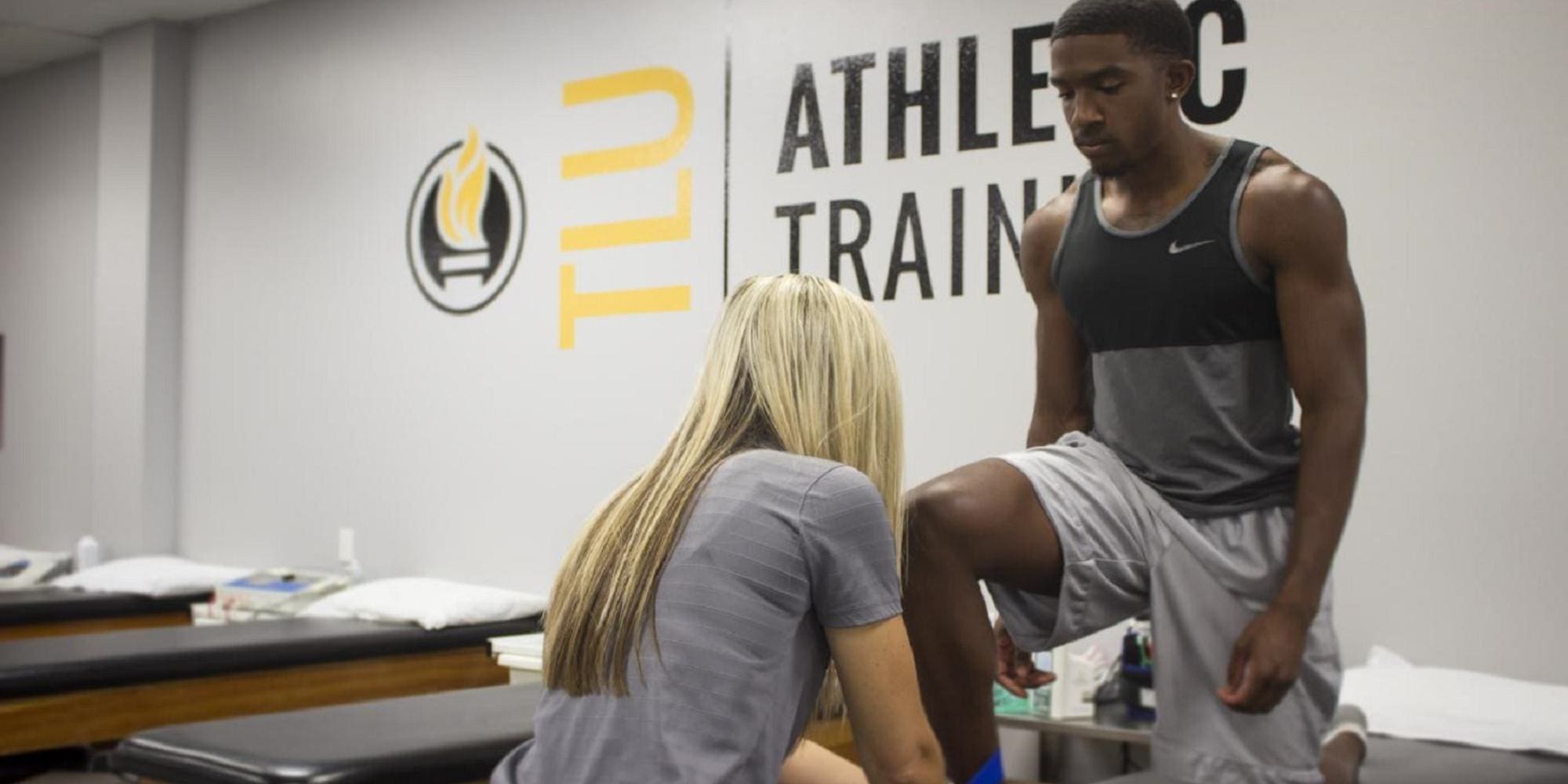
Athletic Trainers (ATs) are health care professionals who work in a variety of locations under the direction of a physician to provide preventive services, emergency care, clinical diagnosis, therapeutic intervention, and rehabilitation of injuries and medical conditions.
To become an Athletic Trainer
- Complete a graduate-level curriculum accredited by the Commission on Accreditation of Athletic Training Education (CAATE).
- Complete the Board of Certification (BOC) examination.
TLU’s CAATE-Accredited Master of Athletic Training (MAT) program
- Traditional Master’s Track: Students already holding an undergraduate degree can apply directly to the graduate portion of the program and complete the Master of Athletic Training degree in two years.
- 5-year Concurrent Track: Complete your undergraduate and graduate degrees concurrently, earning both a Bachelor of Kinesiology and Master of Athletic Training upon completion.
What is an Athletic Trainer?
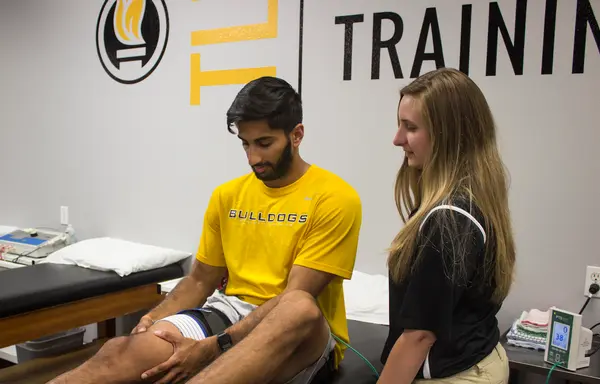
Athletic trainers (ATs) are highly qualified, multi-skilled health care professionals who render service or treatment, under the direction of or in collaboration with a physician, in accordance with their education, training, and the state’s statutes, rules, and regulations. Athletic Training is recognized by the American Medical Association (AMA) and the Department of Health and Human Services (HHS) as an allied health care profession.
As a part of the health care team, services provided by athletic trainers include:
- Primary care
- Injury and illness prevention
- Wellness promotion and education
- Emergent care
- Examination and clinical diagnosis
- Therapeutic intervention
- Rehabilitation of injuries and medical conditions
Careers in Athletic Training
You’ll be ready to jump into your career the moment you earn your MAT degree. TLU graduates are currently working in military settings, in industrial and occupational health settings, across all levels of collegiate sports, and in high schools, clinics, and hospitals.
Athletic trainers treat a range of patients and can work in a variety of settings. Regardless of their practice setting, athletic trainers practice according to their education, scope of practice, and state practice act. Some of the most common settings Athletic Trainers are found in include:
- Public and private secondary schools, colleges and universities, professional and Olympic sports
- Youth leagues and municipal and independently owned youth sports facilities
- Physician practice, similar to nurses, physician assistants, physical therapists and other professional clinical personnel
- Rural and urban hospitals, hospital emergency rooms, urgent and ambulatory care centers
- Clinics with specialties in sports medicine, cardiac rehab, medical fitness, wellness, and physical therapy
- Occupational health departments in commercial settings, which include manufacturing, distribution, and offices, to assist with ergonomics
- Police and fire departments and academies, municipal departments, and branches of the military
- Performing arts, including professional- and collegiate-level dance and music
Advantages at TLU
Hands-on Patient Care Experience Begins in the First Full Semester and Includes:
- Evaluation of injury and illness
- Creation of rehabilitative exercise programs
- Communication with medical professionals, athletic trainers, coaches, and other athletic staff
- Travel with individual athletic teams
Small Cohort-Style Program Allowing for Individualized Instruction and Attention
The second year includes two separate immersive clinicals dedicated to the totality of being an Athletic Trainer. The final semester 16-week immersive experience is based on student request and can be completed anywhere in the country.
Previous Placements Include:
- University of Missouri
- Boston Free Jacks Rugby
- The University of Texas at San Antonio
- FC Dallas
- Houston Dynamo and Dash
- Louisiana State University
- Various Texas high school settings
The Option of Two Degrees in One
Earning a Master of Athletic Training (MAT) degree can be completed at the same time as a Bachelor of Science (BS) in Kinesiology. Both degrees can be earned over the course of five years.
Hands-On from Day One
You’ll be working in real clinical situations with real patients. As your expertise grows, you will engage in more hands-on patient care. This will include injury evaluation, on-field immediate care, rehabilitation design, and preventative programming. You will be able to make important healthcare decisions based on knowledge and experience.
Immersion in the Profession
In their final two semesters, students complete two separate immersive clinical experiences. During these experiences, academic coursework is delivered online, allowing students to dedicate most of their time to clinical learning. Students mimic the schedule of their clinical site to experience the totality of being an athletic trainer and to fine tune their decision-making skills. The final immersive experience allows students the flexibility to complete their clinical education in the setting and location of their choice. Previous immersive settings have included professional-level sports, high school and college athletics, physician office practices, and public safety. At graduation, you will have spent countless hours fine-tuning your decision-making skills and expanding your practical knowledge.
Small Classes
Small classes make a difference and Athletic Training classes are among the smallest at Texas Lutheran University. You’ll be in a cohort of 10-12 students, allowing you to get more one-on-one time with professors and preceptors.
Accreditation & Certification

TLU’s Athletic Training Program gained accreditation in 2005 from the Commission on Accreditation of Athletic Training Education (CAATE) and received a 10-year accreditation award for 2020–21 through 2030–31. Upon completion, students are eligible for national certification through the Board of Certification (BOC) and for Texas State Licensure. For more information, visit caate.net.
Admissions & Program Requirements
Concurrent Bachelor’s & Master’s Degrees
Materials needed to complete an application file include:
- A concurrent graduate student application provided by the Office of Admissions.
- Official transcripts from all institutions attended not listed on the TLU transcript.
- One academic and one professional recommendation letter
Direct Admission to MAT Program
Materials needed to complete an application file include:
- Application for Admission through the Athletic Training Centralized Application System (ATCAS)
- Official transcripts from all institutions attended
- Supplemental Program Form: This includes an essay on your professional goals
- Graduate addendum
- One academic and one professional recommendation letter
Applications are due March 1 for students beginning the following summer semester.
All applicants who wish to be considered for the MAT program must also:
- Have a minimum of a 3.0 cumulative GPA on a 4.0 scale for all college coursework,
- Complete TLU’s general education and Kinesiology Major requirements OR hold a Bachelor’s degree from an accredited university before beginning program coursework, and
- Complete, with a C or higher, the TLU equivalents of the following coursework:
BIOL 235: Nutrition
BIOL 245: Human Anatomy and Physiology I
BIOL 246: Human Anatomy and Physiology II
CHEM 147: Principles of Chemistry
KINS 238: Foundations of Athletic Training
KINS 335: Exercise Physiology
KINS 476: Biomechanics
PHYS 141: General Physics
PSYC 131: Introduction to Psychology
STAT 374: Statistics
All applications are obtained and submitted through the TLU Admissions Office. Students whose application files meet the admission criteria will be reviewed by the Athletic Training Admission Committee. Applications will be evaluated and ranked based on the above criteria. Students accepted into the professional phase of the program will be required to sign a technical standards document and submit a general medical physical completed by a medical doctor before beginning the clinical portion of the program.
View the Program Cost Sheet
If you are a current or prospective student interested in pursuing licensure or certification in another state, we recommend you review your state’s licensure or certification requirements.
Learn More About Our MAT Program
Want to connect with current MAT students and our faculty? Sign up to be included on our email list so you’ll receive information about visits, tours, and other opportunities to engage with our faculty and students.
Do you have a question? Get in Touch.